
Use case · Product configurator
The Screw Conveyor Configurator
That Lives on the Open Web
A customer picks length, diameter, and drive position on Vagen's website. Minutes later they're rotating the 3D model in their browser and downloading the STEP file. No email thread, no engineer, no waiting for the office in Norway to open.
The challenge
Where Every Inquiry Used to Stall
Before the configurator, a conveyor quote at Vagen Conveyors was a relay race. Sales collected requirements over phone or email. An engineer opened Autodesk Inventor and modeled the conveyor from scratch: 4-6 hours per configuration. The files went back to sales, sales sent them on, and 2-3 business days had passed. For a Norwegian company selling worldwide, time zones stretched that further still.
Constraints & Challenges
No engineer in the loop
Inventor had to model and draw each conveyor entirely from web inputs, with nobody reviewing the output before the customer saw it.
Built for buyers, not drafters
The people configuring conveyors are purchasers and plant engineers, not CAD users. Exposing raw Inventor parameters was never an option.
Minutes, or it fails
A customer mid-browse won't wait an hour for a model. Generation had to finish while they were still on the page.
Real files, not pictures
Customers needed STEP, Inventor, and PDF outputs they could drop straight into their own plant layouts.
Part of the website
The configurator had to sit inside Vagen's existing site and look like it belonged there, not a bolted-on portal.
The solution
What FDES Built
A public configurator on Vagen's website, with real Autodesk Inventor doing the modeling server-side, driven through Autodesk Platform Services.
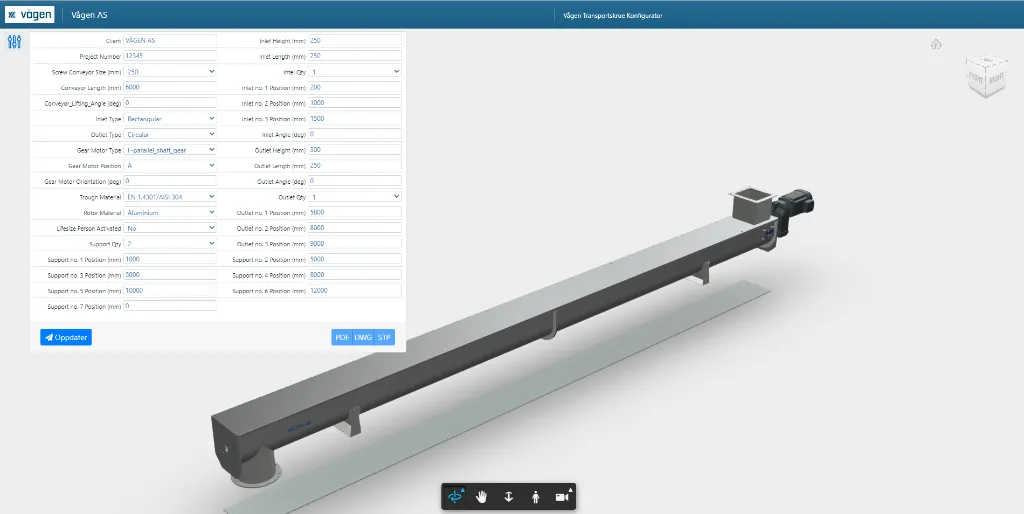
- A web form captures the configuration (length, diameter, pitch, materials) and validates it before anything is submitted.
- Each valid configuration fires a Design Automation job that builds the Inventor model and drawing in the cloud.
- The finished model streams into a browser 3D viewer, so the customer inspects it within minutes of clicking generate.
- STEP, Inventor, and PDF files are packaged for download the moment the job completes.
- Webhooks push job status back to the page: a live progress indicator instead of a spinning wheel.
Scope
What Was Automated
Measured in production
Impact
Speed
A quote that meant 4-6 hours of Inventor work now generates in under 10 minutes per configuration.
Responsiveness
Inquiries answered the same day. Customers used to wait 2-3 business days for a drawing.
Self-service
60% of standard orders are configured by the customer, end to end, without sales touching them.
Capacity
Monthly quotation volume grew 5x, with the same sales engineering headcount.
After deployment
What Changed After Deployment
The old relay (sales gathers specs, engineering models, sales relays the files back) capped how many inquiries Vagen could handle in a week. Every handoff added a delay, and every quote consumed engineering hours whether the order landed or not.
For standard conveyors, that relay is gone. A customer opens the configurator, sets length, diameter, pitch, material, and inlet and outlet positions, and watches the model render. They turn it over in the embedded Forge Viewer, check the details, and take the STEP, Inventor, or PDF files, often before anyone at Vagen knows the inquiry happened.
In day-to-day terms:
- 60% of standard orders never touch the sales team. The customer configures, inspects, and downloads on their own, inquiry to deliverable.
- Sales engineers now work only the hard cases: non-standard lengths, unusual materials, multi-conveyor systems that genuinely need judgment. Better use of their expertise, and by their own account, better work.
- Lead time collapsed from 2-3 business days to same day. Outputs arrive in minutes, and a buyer nine time zones away no longer waits for the Norwegian office to open.
- Global reach grew without hiring. Time zones and language had always dragged on Vagen's international sales. A visual, self-service interface removed both: customers in Asia, the Middle East, and the Americas configure and download at any hour, no phone call required.
- Engineers got their week back. Hours once spent modeling standard conveyors for quotes now go to product development, custom projects, and extending the configurator's rule set to cover more variants.
It changed selling, too. At trade shows and customer meetings, reps hand prospects the configurator and let them build their own conveyor on the spot. Sales cycles shortened, and in a market where competitors still quote by hand, the demo itself makes the argument.
Design decisions
Why This Approach Worked
The results trace back to a handful of deliberate calls, made early.
- Public, not internal. The single biggest decision was putting the configurator in customers' hands instead of building a tool for sales. That removed the bottleneck rather than relocating it, and changed the ratio of staff effort to orders processed for good.
- Show the model before the download. Live 3D in Forge Viewer lets a customer verify the conveyor from every angle before committing. No more submitting parameters and hoping the result matches; revision rounds dropped and first-time order accuracy rose.
- Push, don't poll. Webhooks stream job status to the page as the Design Automation run progresses, and the viewer loads the moment the model is ready. Heavy server-side Inventor work ends up feeling like an app responding in real time.
- The rules never leave the server. Every parametric relationship, validation check, and BOM calculation runs behind the Design Automation API. Vagen's engineering know-how is never shipped to the browser, and a rule update deploys once, centrally, for every user at once.
- Written for non-engineers. Plain-language labels, sensible defaults, grouped parameters, and validation that blocks bad inputs before submission; nobody ever meets a cryptic Inventor error. That low floor is the reason 60% self-service was reachable at all.
- Launch small, extend deliberately. The first release covered a limited set of variants. Each automation rule proved itself against real customer orders before the catalogue widened; edge cases surfaced early, and confidence in the outputs was earned, not assumed.
Every one of these choices removed friction for someone: the customer configuring, the rep managing inquiries, the engineer maintaining rules. That's the pattern worth copying: automation that simplifies a workflow becomes indispensable; automation that adds a layer gets abandoned.
Compare
Before vs After
- 4–6 hours of engineering behind every quote
- Each inquiry queued for an engineer's desk
- Drawings arrive after 2–3 days of waiting
- BOMs and pricing assembled by hand, sometimes wrongly
- A finished configuration in under 10 minutes
- 60% of standard orders run with no staff at all
- Model and drawings in hand the same day
- Zero BOM errors: the rules do the arithmetic
Stack
Technologies Used
Your product next
Does Your Product Follow Rules?
If your conveyors, enclosures, or machines vary by parameters rather than reinvention, they can quote themselves. We build configurators that output real CAD, not just a price.
- Web inputs mapped straight to CAD models, drawings, and BOMs
- Your engineering logic stays server-side, never exposed
- Customers download real files, not renderings
- Rolled out variant by variant, proven on live orders
Related
Related Use Cases
3D Workstation Configuration Platform
One sales pick-list drives the model, drawings, and BOM for every variant.
Commercial Kitchen Drawing Variants
Gaylord's drawing packages: 3–5 days down to under 4 hours.
Utility Structure Design Automation
Structure design and detailing: 2 weeks down to 2–3 days.