
Sales order in → price · BOM · CAD out
Product Configurator Development
that thinks like your engineers.
Sales promises a quote by Thursday. Engineering finds out Monday, then spends two days checking the configuration by hand, redrawing the layout, and re-pricing it in Excel. We end that loop. Your engineering rules go into the configurator once; from then on, sales picks options and the quote, BOM, and drawings come out together, already valid.
Definition
What Is a Custom Product Configurator?
A product configurator is software that turns option selections into a valid, priced, buildable product definition. A custom product configurator goes further than off-the-shelf CPQ: it carries your actual engineering rules, so the same configuration run that produces the quote also generates the CAD drawings, 3D models, and ERP-ready BOMs. Off-the-shelf configurator software prices an option list; a configurator built on your engineering logic guarantees the thing it quoted can be manufactured. It is CAD automation with a sales-facing front end.
The bottleneck
Every quote is waiting on an engineer
The price list says one thing. The product allows another. The only person who knows the difference is a senior engineer, so every order, even the routine ones, queues up behind engineering. Meanwhile your customer is comparing turnaround times.
90% faster quotes
Routine configurations price themselves: quote turnaround drops by 90%, and the queue behind engineering disappears.
Zero invalid configs
If a combination can't be built, it can't be selected. Engineering rules, CAD constraints, and pricing logic check every choice as it's made.
Documents included
The quote ships with its BOM and CAD files attached. Nothing gets redrawn after the PO lands.
Inside the system
What we actually build
One platform holds your product rules, your pricing, and your CAD logic. Everyone who quotes (rep, dealer, or customer) quotes through it.
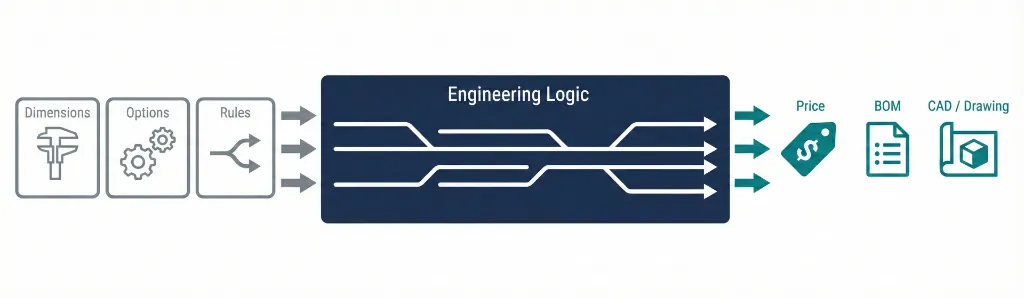
Engineering Rule Engine
- Parametric, constraint-based logic that mirrors how your product actually configures
- Incompatibilities and dependencies blocked at selection time, not at review
- Rules modeled at engineering depth, not form-field validation
Configuration Interface
- Separate views for sales, dealers, and end customers
- Every choice checked the moment it's made
- Options appear and disappear as the rules allow
- Runs in a browser, on any device; nobody needs a CAD seat
Pricing & Commercial Logic
- Price follows the configuration, with margin floors built in
- Volume breaks, option pricing, per-customer agreements
- Live pricing pulled from your ERP when you need it
Real-Time 3D Visualization
Buyers watch the product take shape while they choose.
- Geometry updates with every selection
- Driven by the same engineering rules, not a separate mockup that drifts
- Rotate, zoom, and inspect before ordering
- Optionally wired straight into your CAD logic
Automated Outputs
The moment a configuration is confirmed, its paperwork already exists.
Every document comes from the same rule run, so they can't disagree with each other.
Deployment
Three places to put it
Same rule engine underneath every option. You decide who gets to quote through it.
Your sales desk
Reps configure and price on their own. Approvals trigger only where you set the thresholds.
- No engineering queue for standard orders
- One pricing logic across every rep
Your dealer network
Distributors quote inside the guardrails you define: rules, margins, and discounts included.
- Dealer-specific pricing applied automatically
- No back-and-forth email chains
Your public site
Prospects configure the product themselves and ask for a price. You get a lead with a valid spec attached.
- Every lead arrives pre-configured
- Instant budget-level quotes
Why FDES
Why a custom CPQ instead of off-the-shelf?
Because your product is engineered to order, and generic CPQ isn't.
Off-the-shelf CPQ handles option lists and price books. It doesn't know that a longer span changes the bearing, the motor, and the drawing. We start from your CAD and engineering logic, so the configurator can never drift from what your factory can actually build.
Weighing specific platforms? See how we compare: FDES vs DriveWorks and FDES vs Tacton.
Days become minutes
Routine quotes stop touching engineering at all.
Buildable by design
Invalid combinations never make it off the screen.
R&D gets its people back
Senior engineers design products, not quotes.
One price logic
The number doesn't depend on who typed it in.
Integration
It plugs into what you already run
A configurator that doesn't talk to CAD, ERP, and CRM is just a fourth silo. Ours is the layer that connects the other three.
CAD Systems
The rules that price the quote drive the geometry too.
- Models and drawings regenerate from the configuration; nobody redrafts
- What sales configures is exactly what CAD produces
- Variants stay in sync as your rules evolve
→ If it quotes, it builds.
ERP / MRP Systems
Costing and manufacturing see every configuration the moment it exists.
- BOMs flow straight from the rule engine
- Cost is known before the quote goes out, not after
- Nobody re-keys line items into ERP
→ The margin you quoted is the margin you get.
CRM Systems
Quoting happens where your pipeline already lives.
- Configure straight from the opportunity record
- Every deal keeps its configuration history
- Approvals route without escalating to engineering
→ Pipeline speed, engineering discipline.
One rule set feeds configuration, price, CAD, BOM, and ERP. Change a rule once, and everything downstream changes with it.
Who it's for
Do you need a product configurator?
You'll recognize yourself in at least one of these.
You build to order
Every PO triggers hours of quoting, BOM assembly, and drawing work, for products that follow rules everyone already knows.
Sales waits on engineering
Reps can't send a number until an engineer signs off, and the sign-off queue is days long.
Orders grow faster than headcount
Volume is heading toward 3× and hiring engineers takes months. The gap has to come from somewhere.
Your options explode
Hundreds of valid combinations, and the constraints between them live in two senior engineers' heads.
Client results
Measured on live deployments, not demos
"Our sales team now generates accurate quotes with engineering-grade drawings in minutes, not days. Engineering is no longer a bottleneck in the quoting process. The configurator paid for itself within 4 months."
Shipped systems
These are quoting orders right now
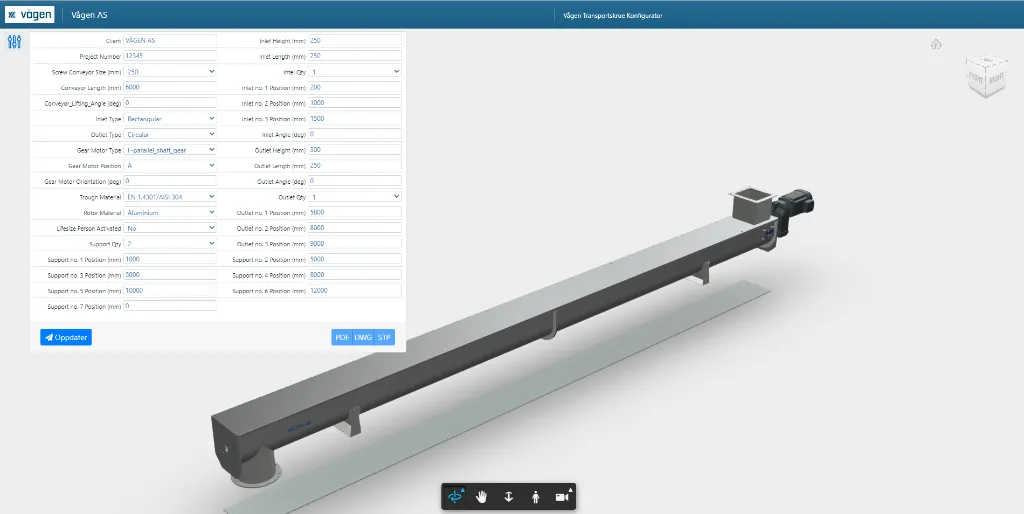
Web-Based Screw Conveyor Configurator
A sales team prices and configures screw conveyors in a browser. CAD, BOM, and quote generate behind the scenes; engineering never opens a file. Quote capacity rose 5x with the same headcount.
Read the use case →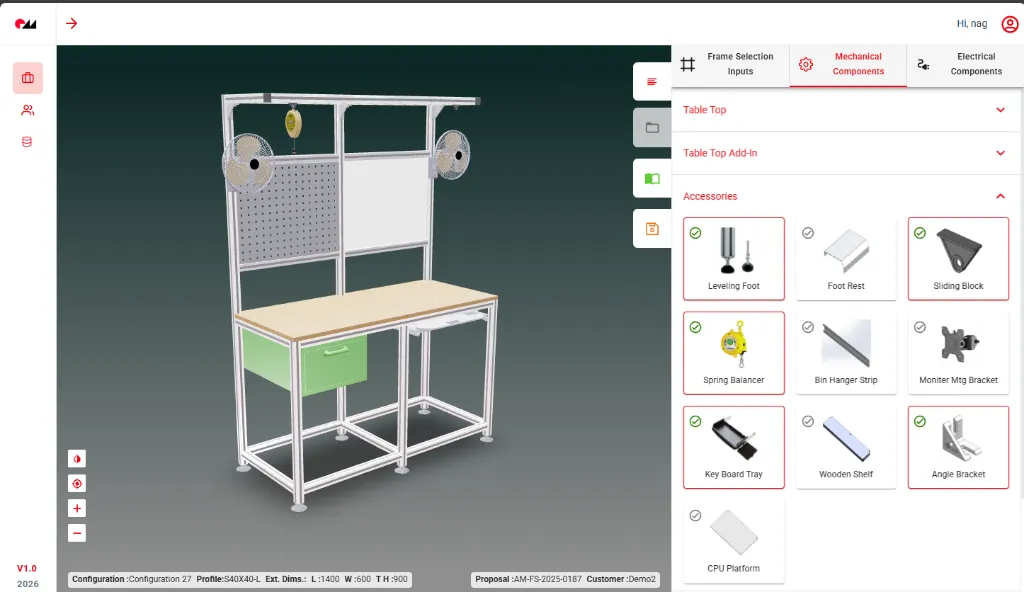
3D Workstation Configuration Platform
Customers assemble industrial workstations visually in the browser while the rule engine permits only valid combinations. Configuration moved from engineering's queue to the point of sale.
Read the use case →Questions we hear
Questions buyers ask before starting
What's the difference between a product configurator and a standard CPQ tool?
A standard CPQ tool prices an option list; it has no idea whether the combination it just priced can be manufactured. Our configurators carry the engineering with them: the same rules that validate a configuration also generate its CAD drawings, BOMs, and calculation reports. One run produces the quote and the documents to build it.
Can non-engineers use the configurator?
That's the whole point of building one. Sales reps, dealers, and customers pick options in a guided interface while the engineering rules do the checking silently. Anything unbuildable is blocked before it can be selected, with no CAD knowledge required anywhere in the process.
Which platforms do you build configurators on?
It depends on where your CAD logic lives. For SolidWorks shops we typically build on DriveWorks; for Inventor, iLogic; Tacton where it fits; and custom web platforms in .NET/Python when you need a browser front end or unusual rule depth. We recommend a platform after seeing your products, not before.
How long does it take to build a configurator?
Plan on 4-8 weeks for a working prototype covering one product family, enough to quote real orders and prove the rules. Reaching full production, with ERP integration and multi-user rollout, typically takes 3-6 months. Product-family count and rule complexity drive where you land in that range.
Should we buy configurator software or have one built?
If your product is an option list with prices, buy an off-the-shelf configurator; it will be faster and cheaper. Build when the configuration logic is genuinely engineering: when a longer span changes the bearing, the motor, and the drawing. Off-the-shelf tools don't carry that logic, and bolting it on afterward costs more than building around it from the start.
What does product configurator development cost?
Typical builds run $30K-$100K+ depending on product complexity, rule depth, 3D visualization, and integrations. That's a one-time build cost, not an annual per-seat license, which is why the comparison against subscription CPQ usually favors custom within 2-3 years for engineering-heavy products. The free audit produces a real number for your product.
Do we own the configurator?
Yes. This is custom development, not a licensed platform: you own the source code, the rule sets, and the deployment. No per-user fees, no vendor lock-in, and your product knowledge stays your property.
Industries
Where these systems earn their keep
Free session · engineers on the call
Your engineers already know the rules. Let's make them quote.
Bring one product family. In a free engineering-led session we map how it's quoted today, find where the hours go, and tell you honestly whether a configurator pays off, and how fast.
- One product family mapped, inquiry to PO
- The quoting steps worth automating, ranked
- A realistic path: working pilot in 4–8 weeks
- A straight answer if CPQ isn't the right tool yet
Related insights
Reading for teams weighing a configurator
Product Configurators vs CPQ Software: What Engineers Need to Know
Read article → AUTOMATION STRATEGYBuild vs Buy a Product Configurator: How to Actually Decide
Read article → BUSINESS CASEDriveWorks Cost vs a Custom Configurator: The Real TCO Compared
Read article → CAD CUSTOMIZATIONiLogic vs Inventor API: Choosing the Right Automation Approach
Read article → BUSINESS CASECAD Automation ROI: How to Calculate the Return on Design Automation
Read article →Other services