
Free tool · no account · nothing stored
PLS-POLE Results Summary
One page for the whole run: pole and tubes, usage by load case, insulator and davit usages, tip deflections, support reactions and every table PLS-POLE wrote. Values are shown exactly as reported in the results XML, with their units. Add the model files and the tool also checks that they belong together.
Add model files for cross-file checks (optional): .pol, .spp, .lca
The sample is the spoex5 example shipped with PLS-POLE, run with nonlinear analysis, together with its model files. The status describes the imported results and, when model files are added, the file checks. It is not an engineering approval and does not replace PLS-POLE Model Check.
How to export the results XML from PLS-POLE
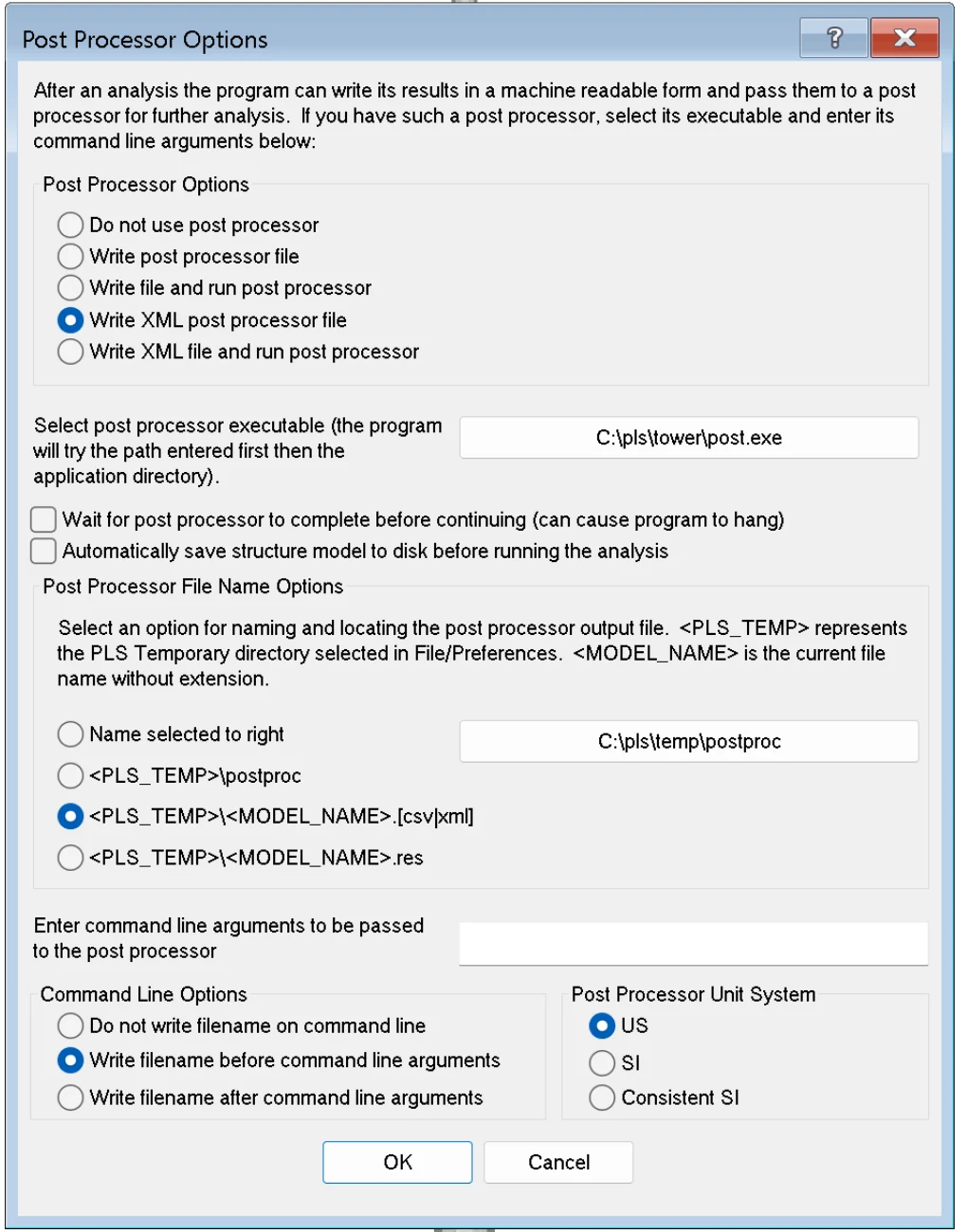
- Open the model in PLS-POLE and go to General > Post Processor Options.
- Select Write XML post processor file. Leave the "run post processor" options unselected.
- Under file name options choose <PLS_TEMP>\<MODEL_NAME>.[csv|xml], or "Name selected to right" with a folder of your own. Keep the unit system you work in; the tools read the units from the file.
- Click OK, then run the analysis with Model > Run. The XML is written when the analysis finishes.
- Find the file. The PLS temporary folder is row 2, Temporary Directory, in File > Preferences, typically
C:\Users\<you>\AppData\Roaming\PLS\temp. The file is named after the model, for examplespoex5.xml. - Check the file size before uploading. A zero-byte file means the analysis did not complete, or the option was changed after the run.
- The XML holds results only. Re-run the analysis after every model change and upload the fresh file.
- For the cross-file checks keep the
.pol,.sppand.lcathat belong to that run together with the XML.
Full guide with the Preferences screen, the library location and how to save a load file: Export results XML from PLS-POLE.
From this XML to fabrication drawings
The Pole Passes. Now Automate the Drawings.
FDES turns PLS-POLE analysis output into 3D models, fabrication drawings and BOMs on Inventor, AutoCAD or SolidWorks, to your templates and part numbering. Bring one pole and we will show you the workflow.
- Tube schedule, seams and holes modelled automatically
- Dimensioned fabrication drawings and BOM in agreement
- Deployed with US steel pole manufacturers
- Free automation audit, no commitment